Posts

Showing posts with the label Research Techniques

Andrew Goodwin- 'Dancing in the Distraction Factory'

Image
Andrew Goodwin, often described by those in the industry as 'the professor of pop' theorised six key aspects that videos should meet in order to ensure a successful music video. These were summarised in his publication, 'Dancing in the Distraction Factory' as: Music videos have genre characteristics, for example a boyband might have a choreographed routine whereas a metal band would follow a stage performance. Relationship between visuals and lyrics- this relies on the use of semiotic meaning, used frequently throughout the film and media industry."semiotics is the study of signs, their meanings and interpretations, meaning that semiotic imagery in this case would be relative to the lyrical content of the song, so for example if the word 'cat' was to be used, an image of a cat could appear on screen signalling the viewers relation between the image of the cat and the word, even if that particular semiotic is not directly related to the lyric as a whole p...
Unit 11: Film Studies- Final Essay

Does Martin Scorsese Represent Fragile Masculinity With Regards To Laura Mulvey's A "Visual Pleasure and Narrative Cinema" and Aspects of Freudian Theories of Psychoanalysis in "Goodfellas" and "The Wolf of Wall Street"?     Martin Scorsese, regarded by many as "the greatest living director" ( Ricky Gervais, 2020), has always remained true to his sense of self, or auteur approach, within his productions, setting him aside from the norms of Hollywood and breaking the rules of cinema frequently in his productions; in his own rights, Scorsese helped to pave the way for young, aspiring directors and still inspires many to this day. However, many of Scorsese's works have been critisesed for their diminishing view on women, and the deeper messages of both disrespect and insecurity that this conveys. Two films which particularly stood out to me when breaching this subject, for completely adverse reasons, were "Goodfellas...

Freud's Theory of Self and Personality.

Image
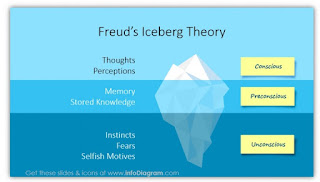
Freud's Psychoanalytical Theory of Self and Personality Within Relation to Cinema and Film.  What is Freud's theory? Sigmund Freud is seen as a founding father of psychoanalytic study, or study of the human mind and the way that it functions. Freud's "psychoanalytic theory of personality argues that human behaviour is the result of the interaction between three component parts of the mind: the id, the ego and the superego" ( Karen Horney, 2015).  According to "The Ego and The Id" ( Sigmund Freud, 1923 ), the human personality develops from interactions between these three fundamental structures of the mind.  the Id- the most primitive of the structures, the Id is concerned only with the instant gratification of basic and primitive needs and urges such as sex and desire. The Id operates unconciously meaning that we have no control over it. the Ego- the Ego is the rational and pragmatic part of the human psyche; it is less primitive than...

The Theoretical Perspectives of Freud Research

Image
The Theoretical Perspectives of Freud Freud was " an Austrian neurologist and the founder of psychoanalysis, who created an entirely new approach to the understanding of the human personality. He is regarded as one of the most influential - and controversial - minds of the 20th century.  Freud developed the theory that humans have an unconscious in which sexual and aggressive impulses are in perpetual conflict for supremacy with the defences against them. In 1897, he began an intensive analysis of himself. In 1900, his major work 'The Interpretation of Dreams' was published in which Freud analysed dreams in terms of unconscious desires and experiences.   Although the medical establishment disagreed with many of his theories, a group of pupils and followers began to gather around Freud. In 1910, the International Psychoanalytic Association was founded with Carl Jung, a close associate of Freud's, as the president. Jung later broke with Freud and developed his own th...

Development of Editing Techniques

Image
The Development of Editing Techniques The birth of cinema... Auguste and Louis Lumiere were "pioneer manufacturers of photographic equipment who devised an early motion picture camera and projector called the Cinematographe" ( Editors of the Encyclopaedia Brittanica, 2013) Early Editing...   The first editing technique to come into play in the world of cinema was cutting; before cutting directors would film in one continuous shot with no editing. "Cutting is so fundamental to the medium that it began to emerge relatively quickly" ( filmreference.com). Cutting became more widely used when directors and audiences alike desired for longer films became higher and there was only a small amount of magazine a film camera could hold. Being able to cut scenes allowed for a longer and more complex narrative "by assembling a series of scenes, with each scene filmed in a single shot" ( filmreference.com). In the 1900s cutting was achieved by actual...

Health and Safety

Image
Health and Safety Health and safety is in place to keep everybody on the set safe, "sticking to your H&S plan is crucial, and yes common sense is a key factor. It is also about working through your shoot in advance to make sure that you have that very plan in place". (Peter Clews, 2019) In the words of director, Stephen Spielberg, "no movie is worth dying for" Health and Safety Legislation and Procedure "Health and Safety legislation applies to all work activities in the UK, whether conducted by UK nationals or foreigners, even if they are not being paid" HSE. Recognised by law, health and safety should be at the forefront of the mind throughout the process of filming and producing.  The Health and Safety Executive guidelines, endorsed by the UK Government state that a management system should be in place to  define responsibility to "control the risk to employers or others from their work", management systems should be devised...

Different Types of Lighting

Image
Different Types of Lighting L ighting plays a key role in moving image; "Lighting is fundamental to film because it creates a visual mood, atmosphere, and sense of meaning to the audience"- David Lynch (2013). The correct use of lighting tells the audience where to look on the screen, can be indicative of the character's psych key and often contributes to the genre that the film is classified as. In the photography studio, we used a three point lighting set up with various different types of lighting to explore how this affected the atmosphere and mood of the footage. Rembrandt Lighting Rembrandt Lighting is a popular lighting set up named after the Dutch painter Rembrandt who used this particular style of lighting within his portraits int he 17th century. It is made up of one light source illuminating half of the face, and a triangle of light illuminating the other side of the face below the eye, known as a chiaroscuro. The light source must be higher than a...

New Wave Film Brief

New Wave Film Brief I plan on creating a new wave film, focussing on the effect that Brexit is having on the working class in the UK. My film will be two to three minutes long and the narrative of my film will follow the story of a woman, representative of Britain, dancing with the devil of the Conservative Government. I intend to shoot footage in an interview style with my peers, asking for their opinions on the current political climate and the government which I will then edit in a jump- cut manner with stock footage from political sources to demonstrate the swiftly darkening opinion of the 'tory' party in the youth in Britain. Further to this, I intend to make a statement within my film, insinuating the demise of the UK at the hands of our Government; in order to do this I intend to use low-key lighting in a dimly lit room, personifying Britain in the character of a woman  and I will shoot Britain dancing with the devil, using edge lighting and rembrandt lighting to gi...

The American Cinematic New Wave

A Contextual Study Exploring the American New Wave from 1969-1987       This writing explores the American Cinematic New Wave from the period of 1969-1987, taking into consideration social, moral and political influences on cinema and upcoming directors. I will investigate the flourish of a fresh creative freedom that the new wave brought to America, allowing a generation of passionate filmmakers to break through the boundaries of traditional Hollywood films. Works such as ' Easy Rider'  ( Dennis Hopper, 196 ), ' Taxi Driver' (Martin  Scoursese , 1976',  and  'Full Metal Jacket' (Stanley Kubrick, 1987)  embodied the raw self- awareness and evident rule breaking of new wave cinema, with a determination to shatter studio censorship within films and to present their audiences with a different, more cynical and critical perspective on the societies which they portrayed.    The Second World War altered Hollywood productions t...