Posts

Analytical Study of Agreed Perspectives

To What Extent do Contemporary Music Videos from Alternative/Indie Rock Make Use of Stereotypical Conventions and Dominant Views of Representation. Both Music and Film are regarded as well-respected, ever-growing and easily accessible forms of art, both of which seek to inform the audience of an intended view point or opinion. Music videos tie the two mediums together in a sweet matrimony of visual and aural representations and concepts, and are generally produced in order to promote an artist or band's work to the public in an engaging and relative manner. In this study, I will be analysing a series of music videos from the genres of Alternative or Indie music from a number of different artists, delving in to explore  common or 'stereotypical' conventions and popular, dominant views such as the portrayal of relationships, performances, day to day life, mood and mental health, making music videos and similar productions more relatable and enjoyable to their catchment a...
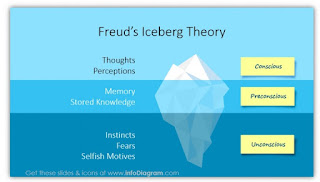
Freud's Theory of Self and Personality.

Image
Freud's Psychoanalytical Theory of Self and Personality Within Relation to Cinema and Film.  What is Freud's theory? Sigmund Freud is seen as a founding father of psychoanalytic study, or study of the human mind and the way that it functions. Freud's "psychoanalytic theory of personality argues that human behaviour is the result of the interaction between three component parts of the mind: the id, the ego and the superego" ( Karen Horney, 2015).  According to "The Ego and The Id" ( Sigmund Freud, 1923 ), the human personality develops from interactions between these three fundamental structures of the mind.  the Id- the most primitive of the structures, the Id is concerned only with the instant gratification of basic and primitive needs and urges such as sex and desire. The Id operates unconciously meaning that we have no control over it. the Ego- the Ego is the rational and pragmatic part of the human psyche; it is less primitive than...

New Wave Film and evaluation

Image
Kill Us All- a Montage of Youth Evaluation: In evaluation, I feel that my film adequately conveys features of New Wave production; I was particularly inspired by the first scene of ' Easy Rider'(Dennis Hopper, 1969), and the idea of a road film. In my film, I wanted to show the youth of Britain today in a different and much more inclusive light, with the intention of displaying that contrary to media headlines and common opinions, that today's youth are curious, interesting and active; in order to do this, I decided to shoot BMX riders in a skate park, on an urban exploration trip and whilst I was out with my friends. In my first shot, I used my iPhone 7 camera to film in homage to hand held film cameras such as the Bolex 16mm and the Arriflex 35-BL that were commonly used in the American New Wave by directors such as Stanley Kubrick, Dennis Hopper and Martin Scoursese in their lower budget production. Although this created camera shake due to not being ab...

Freud's Theory of 'The Self' and Fight Club (1999)

Image
A Freudian Analysis of David Fincher's Fight Club (1999) The Bar Fight scene from David Fincher's Fight Club (1999) In David Fincher's fight club, Freud's theory of "The Self' can be frequently applied to the narrative. The concept relates to Freud's theories on the personality entailing of three separate parts, the Id, the Ego and the Superego. Fight club is the story of an average man, who is so generically average that he does not have a name. In the credits, Fincher refers to him simply as 'The Narrator'. His life is monotonous, and everything is  "a copy of a copy" ( Fight club, 1999). Until he meets Tyler Durden on a plane when he is travelling for a business trip; Tyler is the direct opposite of the Narrator, but also everything he desires to be at the same time. ( Unknown, 2014)  Tyler Durden, played by Brad Pitt displays the sex appeal that the Narrator (played by Edward Norton) wishes that he had, and isn't tied to ...

Unit 1- Contextual Studies Essay

A Contextual Study Exploring the American New Wave from 1969-1987     This writing explores the American Cinematic New Wave from the period of 1969-1987, taking into consideration social, moral and political influences on cinema and upcoming directors. I will investigate the flourish of a fresh creative freedom that the new wave brought to America, allowing a generation of passionate filmmakers to break through the boundaries of traditional Hollywood films. Works such as ' Easy Rider'  ( Dennis Hopper, 196 ), ' Taxi Driver' (Martin  Scorsese , 1976',  and  'Full Metal Jacket' (Stanley Kubrick, 1987)  embodied the raw self- awareness and evident rule breaking of new wave cinema, with a determination to shatter studio censorship within films and to present their audiences with a different, more cynical and critical perspective on the societies which they portrayed.        The Second World War altered Hollywood produ...